Friday, 13 May 2016

Week 25: My Community of Practice

I'm @kiwiallana and have enjoyed growing as a teacher at Springston School for 10 years.

Who is my community of practice'?
According to Wenger, everyone participates in a range of communities of knowing or practice (CoP). They share a passion and interact on a regular basis to promote a common goal. This is where new learning is brought to challenge and develop the growth of the community. My CoP focus on education and include school, cluster, Wananga of Aotearoa, Twitter, Feuerstein, and colleagues on the Mind Lab course.

The purpose and function of my practice is education, including the promotion of Te Reo, effective use of ICT and best learning outcomes for students. Within school we discuss student learning needs but I find my most effective exchanges to be within groups that have formed for a specific purpose: The Feuerstein Method, The Mindlab Course and most effectivelly - Twitter.

While colleagues in my Twitter CoP are scattered around the world, they challenge me to question my practice, read current books and apply theories to improve my teaching with our common goal of improving outcomes for all students.
My best ideas come from Twitter and include Daily 5, Positive Mindset, The Learning Pit, and blogging. While I feel more like a lurker, I do share reflections, Te Reo Resources, conference notes and am becoming more active in discussions about educational issues. Twitter leads to great connections at the #educhatnz conference and #educamps - a place to meet many current Mindlab students.

So why reflect?
Part of being in a CoP is to reflect on my practice against the lense of colleagues and educational theories. Finlay (2009) suggests that being critically aware means identifying and challenging my assumptions - essential for lifelong learning. Schon (in Finlay 2009) suggests it takes place after an event but also when I actively reflect and adjust my actions during an event. This core belief fits well as I explicitly teach students to reflect using the language of learning. Reflection is the foundation of recognising that all cognitive function and behaviour are modifiable and that we can achieve anything that is broken into achievable steps. This belief system forms the foundation of the Feuerstein Method. My practice also depends heavily on Dweck’s (2006) positive mindset and utilising a range of learning strategies to help both teacher and student work their way out of Nottingham’s Learning Pit. (2013) The joy comes in seeing that the beliefs I have about effective learning for students also apply to my own life.


There are heaps more key belief systems that pervade my teaching such as Kaitiakitanga and building relationships, but we have run out of space to discuss them.

Reflecting in the form of a blog has always helped me organise my thoughts, be accountable for my intentions and share the journey with my CoP.


References:
Dawson, P. Reflective Practice. Retrieved from https://www.youtube.com/watch?v=r1aYWbLj0U8
Dweck, C. S, (2006). Mindset: How you can fulfil your potential. London: Constable & Robinson Ltd

Nottingham. J, (2013), The Learning Pit, in Challenging Learning retrieved Janurary 12, 2016, from the World Wide Web: http://www.jamesnottingham.co.uk/phpmedia/docs/6f5f268913a78d598e6e93cddd1c3e49.pdf
Wenger, E.(2000).Communities of practice and social learning systems.Organization,7(2), 225-246
Wenger, E., & Trayner-Wenger, B. (2015). Communities of practice: a brief introduction. April 2015, 1–8. http://doi.org/10.2277/0521663636 

Monday, 9 May 2016

Week 25 - Reflective Practice

Reflecting on practiceReflecting on practice is an active learning process whereby practice is analysed in its applied context. This is the point where theory and practice meet and are refined and developed. This reflective practice is underpinned by the notion of reflection-on-action, and continual learning for improved outcomes. However, Finlay (2008) called attention to the “bland, mechanical, unthinking ways” (p.1) of reflective practice, especially for time-constrained professionals. Without critical reflection, superficial thinking might simply reinforce existing assumptions. Therefore, it is important that reflective practice be cultivated and fostered to become effective. It can then be a “powerful tool to examine and transform practice” (Finlay, 2008, p.10). Critical reflection looks at individual concerns within a wider perspective, “connecting individual identity and social context” (Fook & Askeland, cited in Finlay, 2008). It should be done in a systematic manner, be challenged by differing angles and be informed with reliable sources. Adopting a suitable model of reflection could enhance the quality of your reflective practice. For example, Gibb’s six basic stages of the cycle of reflection (cited in Finlayson, 2015, p.726) has some similarity with the Teaching-as-Inquiry model from the Ministry of Education (2009). Alternatively, the more elaborate typology of reflection developed by Jay and Johnson (cited in Finlay, 2008, p.8) could guide you to scrutinise your practice through a more critical lens.
Keeping a reflective journalA reflective journal enables you to integrate knowledge and learning and analyse the significance and implications for your professional practice.
Collaborating through the creation of a reflective journalYour reflective journal may also become a space where you can start to gather thoughts, sketches, mind maps, diagrams you have created and collected and readings to inform particular interests you may have. This could become a useful resource for your research projects. Electronic journals are also able to be shared with others, so there are opportunities for you to share and create networks, whānau of interest, and professional communities of practice.
A reflective journal is an important evaluative learning tool for you as a learner and as a professional. Sharing aspects of your journal and working collaboratively in shared e-reflective journal spaces is part of the reflective process. The feedback you give and receive can be critical for further investigation, reflection, and change.
In this course, we ask you to create weekly reflective journal entries preferably in the form of blog posts. Each post will provide insights into different aspects of your practice.
Note: (Important)
Before you create a professional personal blog you need to consider the moral, ethical and legal responsibilities you have to your organisation with respect to the content you will create, post and share. Most employment contracts set out your obligations around the use of social media which must be considered when you are creating or sharing views on open online platforms.
You can find some helpful information on blogging such as the platforms to choose, the privacy concerns, the copyright license, the length and structure of a blog in this “How Should I Blog” blog.
Once you have created your blog, you can share the address with your fellow students by filling in this form. Even if your blog is private, you can always grant the permission to view later.
Defining your practiceBefore you can fully extend your practice you will first need to be able to define it. You can start your reflective journal by introducing yourself, articulating who you are and what is your professional community of practice. In order to be able to do this effectively you should consider the following aspects of your role:
  • What is my practice?
  • What is my professional context?
  • Who are my community of practice ?
Your teaching practice is based on a particular context within the community that you serve. Etienne Wenger first coined the concept of “communities of practice”, which are defined as “groups of people who share a concern or a passion or about a topic, and who deepen their knowledge and expertise in this area by interaction on an ongoing basis” (Wenger, McDermott & Snyder, 2002, p.4). The members of a community of practice are bound by three distinct elements: the domain, the practice and the community. The community of practice concept is often coupled with the theory of situated learning (Lave,1991), a model of learning that occurs when practitioners interact within the community of practice. A community of practice differs from other group types in terms of learning and knowledge and practice sharing rather than management objectives. In the school context, this occurs through informal learning via daily conversations, lesson reflections and other exchanges (Jurasaite-Harbison & Rex, 2010).
When reviewing your practice, you should consider your specific learning community and how you are situated within your community. Consider how you communicate with, relate and respond to, and meet the goals and aims of your specific area of practice.
Suggested readings
  • Wenger, E.(2000).Communities of practice and social learning systems.Organization,7(2), 225-246 (Available in Unitec Library). In this clearly presented paper, the author explains the concept of communities of practice and the application of this concept with specific suggestions.
Activity 1: My community of practiceAfter reading the Class Notes, create a post where you first define your ‘Community of practice’ with reference to Wenger (2000)’s definition and then provide a critical discussion in relation to any two of the following questions:
  1. What is the purpose and function of your practice? In what ways do you contribute to the community of your practice?
  2. What are the core values that underpin your profession? Evaluate your practice with regard to these values.
  3. What is your specialist area of practice? How does your specialist area of practice relate to the broader professional context?
  4. What are key theories that underpin your practice? Evaluate your practice with regard to these theories.
Fill in the 'Share your blog's address' form http://tinyurl.com/shareyourblogsaddress
References
Finlayson,A.(2015).Reflective practice: has it really changed over time?. Reflective Practice: International and Multidisciplinary Perspectives, 16 (6), 717-730.
Jurasaite-Harbison, E., & Rex, L. (2010). School Cultures as Contexts for Informal Teacher Learning. Teaching and Teacher Education,26(2), 267-277.
Wenger, E., McDermott, R., & Snyder, W. (2002). Cultivating Communities of Practice: A Guide to Managing Knowledge. Cambridge, MA: Harvard Business School Press,

Saturday, 7 May 2016

Week 23: Using evidence

Jonathan Gray wrote a very useful piece for The Guardian newspaper on the limits of data. It is well worth a read and is available from:http://www.theguardian.com/news/datablog/2012/may/31/data-journalism-focused-critical
Gray offers the following pieces of advice about data:
  • Data is not a force unto itself. It is what individuals (or groups) do with data that brings meaning and power.
  • Data is not a perfect reflection of the world. The choices we make about data, including what we choose to collect, how we collect it, how we analyse it and how we interpret our analysis all influence the findings and conclusions we can make.
  • Data does not speak for itself. It requires interpretation and analysis (hopefully by knowledgeable individuals). In education especially, it needs to be understood within its particular context. This might be in relation to a particular class, school, community etc.
  • Interpreting data is not easy. Really understanding what the data is telling us can be very tricky.
Despite these cautions about data, the evidence you collect as part of your teaching inquiry can be very useful.
The following blog post provides some good ideas of how different types of evidence can be used by teachers:
Resources to support you
The TKI website contains some useful resources to support you in using evidence to inform your teaching practice.
For a general overview of the principles of data analysis go to:
For more specific tools and strategies that you can use, go to:
For a good overview of using evidence in schools have a look at the article published by The Digest and uploaded to the platform.
Tasks for this week
1. Read the class notes on interpreting and using evidence.
2. Check out the information available on the TKI website:
3. For more information and detail on using evidence read the article from The Digest uploaded to the portal (also available fromhttp://www.vit.vic.edu.au/SiteCollectionDocuments/PDF/The Digest/1636_The-Digest-Issue-3-08_final.pdf).  

Friday, 29 April 2016

Teacher Inquiry:

http://www.inquirycycle.appspot.com/

Timperley has taken the process through all the steps:
The website talks you through these and gives an example.


It is all based on how will this improve learning for my students. It is also needing evidence and measurable data to use as evidence and to compare and contrast against past data. 

How do I get started?


It might look like this...


Week 20: Class Notes: Teaching as Inquiry

WEEK 20: TEACHING AS INQUIRY
For the past three weeks we have been looking at how you can use research in order to develop an evidence-informed practice. For the next four weeks the focus shifts from using research to becoming a researcher in your own classroom or school setting.
In your practice you are constantly deciding what to do and how to act. You will be evaluating and reflecting (either consciously or subconsciously and often both) on your teaching practice and making judgments on what you should do next. Adopting the stance of teacher researcher formalises these evaluative and reflective processes. As Wilson (2013) explains:
Researching our practice presents the opportunity to problem-solve more intelligently, through drawing on existing research findings and by using rigorous methods to collect evidence which helps clarify our thinking. Experiences of participating in an informed way, and acting freshly, offer the teacher for whom teaching has become a routine a sense of freedom, of meaning, of worthiness and consequently increased self- esteem. (Wilson, 2013, 5)
Concept of teacher as researcher
The concept of the teacher as researcher has a long history in the academic literature. Lawrence Stenhouse in the 1970s first popularised the idea of teachers acting as researchers of and in their practice. Stenhouse believed that ‘educational knowledge exists in, and is verified or falsified in, its performance’ (Stenhouse, 1984, p.110).
Schon (1983) developed the concept of the reflective practitioner, invests teachers with an active role in the procurement and development of the specialised knowledge that they require to become expert teachers. Schon believes that teachers’ personal, practical knowledge is developed only when teachers reflect on their actions:
He [the teacher] reflects on the phenomenon before him, and on the prior understandings which have been implicit in his behaviour. He carriers out an experiment which serves to generate both a new understanding of the phenomenon and a change in the situation. (Schon, 1983, 68).
Lytle and Cochran-Smith (1992) built upon and extended Schon’s theory of the reflective practitioner to suggest that teachers also learn and create new knowledge by assuming an inquiry stance within their practice. They claim that ‘what is worth knowing about teaching includes teachers’ ‘ways of knowing’, or what teachers, who are researchers in their own classrooms, can know through their own systematic subjectivity’ (p.43). Cochran-Smith and Lytle (1999) developed the concept of ‘knowledge-of- practice’, which places teachers at the centre of knowledge production. It assumes that the knowledge teachers need to teach effectively is generated when teachers treat their classrooms and schools as research spaces. Teachers conduct inquiry projects into their practice, as well as interrogating and interpreting the knowledge and theory produced by others, to create knowledge that is applicable and relevant to their teaching context.
The importance of teacher research/inquiry
There are two main themes dominating discussions of why teacher research is important. The first relates to the importance of teacher-created knowledge for improvement in teaching and learning, and in particular student outcomes. The second centres on notions of teacher professionalism. The following quotes represent various reasonings behind the importance of teacher-research or teacher-inquiry.
It is a community of teachers that is needed to work together to ask the questions, evaluate their impact and decide on the optimal next steps … Such passion for evaluating impact is the single most critical lever for instructional excellence – accompanied by understanding this impact, and doing something in light of the evidence and understanding (Hattie, 2012).
The critical characteristics of that extended professionalism which is essential for well-founded curriculum research and development seem to me to be:
  • The commitment to systemic questioning of one’s own teaching as a basis for development
  • The commitment and the skills to study one’s own teaching
  • The concern to question and to test theory in practice by the use of those skills
To this may be added a readiness to allow other teachers to observe one’s work – directly or through recordings – and to discuss it with them on an open and honest basis. (Stenhouse, 1975)
Enquiry stands at the centre of all activities in developing an activist teacher. Professional teachers are viewed as researchers of their own practices, capable of producing worthwhile knowledge about teaching which can contribute their own and others’ professional development (Sachs, 2003).
Teacher research has the potential to act as an important source of teacher and academic professional renewal and development because learning standards at the core of this renewal through the production and circulation of new knowledge about practice (Sachs, 2003).
Teaching as Inquiry: The New Zealand Context
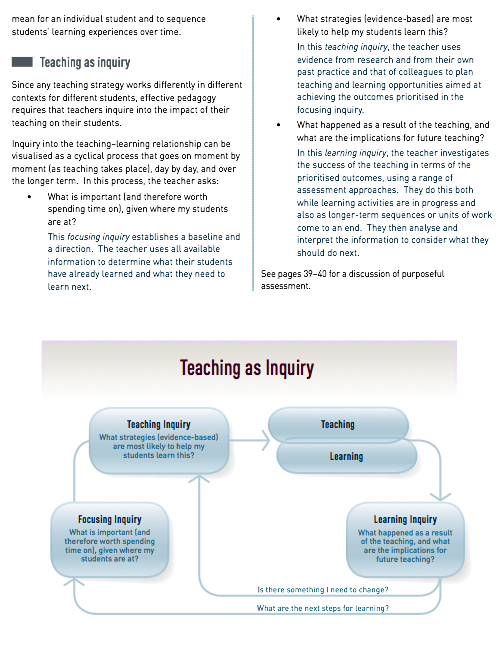
Teaching as inquiry is a process that involves educators investigating the impact of their decisions and practice on students. The New Zealand Curriculum describes it as a cyclical process in which questions are posed, evidence is gathered and decisions are made. Aitken and Sinnema (2008) describe teaching as inquiry as a systematic process for teachers to use in their classrooms, which draws on successful experience of teachers and research sources.
Teaching as Inquiry goes beyond the reflective practices teachers regularly employ to develop a more systematic approach for investigating and evaluating practice. Below is the page from the NZC describing what teaching as inquiry is.
For more information about teaching as inquiry read Graeme Aitken’s background paper, The inquiring teacher (available fromhttp://www.educationalleaders.govt.nz/Leadership-development/Leadership-programmes/First-time-principals-modules/Module-2-Teaching-effectiveness).
It is also worth watching a video Graeme Aitken has made on teaching as inquiry (http://connect.vln.school.nz/ftpmodule2/).
Tasks for this week
1. Read through the class notes on teaching and research in New Zealand. These are designed to give you some background on the concept of the teacher researcher and to provide a brief introduction to the teaching as inquiry model, as it is established in the New Zealand Curriculum.
The following activities will help to give you a better understanding of teaching as inquiry
2. Read Graeme Aitken’s paper on teaching as inquiry and watch the video presentation he gives about the importance and nature of teaching as inquiry. Both are available from: http://assessment.tki.org.nz/Assessment-in-the-classroom/Teaching-as-inquiry/Teaching-as-inquiry-useful-readings-and-links
3. To get more of an understanding of how the teaching as inquiry model can work in practice have a look at some of the short videos, which discuss various inquiry projects that teachers have been involved in.
References
Aitken, G. & Sinnema, C. (2008). Effective Pedagogy in Social Sciences: Tikanga ā Iwi: BES. Wellington: Ministry of Education.
Cochran-Smith, M. and Lytle, S. (1999). The Teacher Research Movement: A Decade Later. Educational Researcher, 28, 15-25.
Hattie, J. (2012). Visible Learning for Teachers: Maximizing Impact on Learning. London: Routledge.
Lytle, S. & Cochran-Smith, M. (1992). Teacher Research as a Way of Knowing. Harvard Educational Review, 62, 447-474.
Sachs, J. (2003). The activist teaching profession. Buckingham and Philadelphia: Open University Press.
Schon, D. (1983). The Reflective Practitioner: How professionals think in action. New York: Basic Books.
Stenhouse, L. (1975). An introduction to curriculum research and development. Portsmouth, NH: Heinemann Publishers.
Stenhouse, L. (1984). Artistry and Teaching: the Teachers as Focus of Research and Development. In D. Hopkins and M. Wideen (Eds.), Alternative Perspectives on School Improvement (pp. 67-76). Lewes and Philadlephia: Falmer Press.
Wilson, E. (2013). School-based Research: A guide for education students. Thousand Oaks, CA: Sage. 

Thursday, 28 April 2016

Using Coding / Computer Science in the classroom: Tracy Henderson

Computer science is about solving problems:
Check out Computer Science Unplugged!

Can we teach computer science with everyday classroom materials.

Sequential programming:
Use a grid of whiteboards as the planning area. Need to get the blue counter to the house. What language could we use to get it there?
De--bug - you said turn, turn, turn, turn ... what could you use to be specific - 45%, clockwise?


Add a range of issues or barriers. How could you solve these problems. F9 - compression rather than F, F, F, F, x9 All answers are right but which is more efficient.

Move into adding the story that supports the plan. Oral language, written language.

Take to a maths challenge - move to the 100 board and pairs. Add different barriers and solve the problems.

Move to seniors... draw story and determine the language F or R 45 with the younger students.

B-Bots:
Place letters, maps, images or compass etc under the plastic mat. Focus on making an activity for the Year 3/4 students. Ideas like constructing a Spanish sentence, adding numbers, matching decimals with fractions...


We are learning programming - not doing SCRATCH. We are focussing on parameters & sequences required for programming. Parameters are what we write on... the programmer decided this. It can't be changed by the user.

Fitness unplugged: (Making a fitness app)
Make an unplugged app that teaches about parameters and loops.
Draw go. I don't know what go looks like. Decide on go.
How do you finish? Computers can't think for themselves, the need to be told.
We want to say something - that is a parameter in the programming. Add a white board to add the writing.

Start, run 10x, burpees, sit. REPEAT (repeat loop)
Put a circle with hoops around the small section - put a circle around it to act as a repeat.
x5 whiteboard so it is not a continuous loop.

In each station - one person is a computer developer. The remainder of the class is doing the fitness activity.

Each day: developers set up the sequence. Kids follow the task. Have 5-6 developers to set up 5-6 stations.


Ideas:
Try a dance sequence, drama sequence.

Binary:
OOps - STRUGGLING!
At the moment - there is no computer in the world that can crack an 8 character password.

Compressing Images: (unplugged site)
Being a human fax and 3D printer.
Following instructions. Keeping to the rule.
Being accurate and precise.
Tracking and systematic ticking off what had been completed.


Bridge: why is it important for the printer to be accurate and precise. Where else is it important to be accurate and precise. 

Action Stations: Laetitia De Vries

Action Stations: 
education designed to nurture children's curiosity for learning and the language they need to become empowered collaborative learners.

Is education the opposite of how our kids best learn - interactive, messy, collaborative?
Does it allow for asking heaps of questions?
Is it inspirational?
Does it leave our kids with memories or does it blur into nothing?

Is there anyone in our kid's lives that says 'you are amazing', 'you are doing great'. Do you as a teacher KNOW your students and do your parents KNOW that you KNOW their child?

How can we make 'School' better? What is the role and purpose of education?

We now have flexible learning spaces and technology that give us opportunities.
How far can we move from traditional teaching? Pushing the boundaries!


Action Stations are not just interactive stations but there is a clear philosophy behind that makes the framework effective. It is not what you teach but how you manage the framework.

Focus:
Empower the community
Student led learning
Focus on collaboration and dialogue
Empower learner with the language of learning
Builds on knowledge
Learning to make choices.
Understand and accept differences, strenghts and AKO co-teach.
Create opportunities to problem solve, be creative...

What to teach - ID issues then teach:
What is learning? What is thinking? How do we know if it is finished? How do we collaborate? How do w know if we are managing ourselves?


If you can't tell me what your learning goal is - then shift.
Put up the week questions at a station. Students can go around an interview where these KC are being used.


Action Stations: 4 steps
  1. Planning - focus question e.g. how can we show commitment in our learning, Key competencies ante key, learner dispositions - manage self -
  2. Set up a learning environment - Number space - creative, problem solve thinking , Construction station e.g. marble run, Co=-ordination station - chopsticks to build a card tower….
  3. Teaching them how to be a learner
  4. Reflection time essential 
The activities are carefully selected to meet the needs.
+ - interesting…. 
Plan changes if the teacher has taught a new skill and wants to station it, add challenges…


Student choice:
Stations ready and able to be carried out without teacher input. They low their learning goals and how to use the equipment. The select when they want to do that working. 

Teach them how to be a learner?

Monday:
Why is it important to do something new? Record ideas and leave for reference. Kids flitting from one station to another.
Wk 2 Qn: When am I finished my work? Issue - working with friends? Who can help my learning?

Always turn things into a question. Never tell them the answer.

Large actions station board. Kids add names to the space.
Quiet and number space - give lots of room to encourage. Stations at the bottom - only 3-4 kids at each station. Own name label. Can change at any time as they choose but can’t touch any other person’s card.

Set up week questions - students go around a interview to see which KC being used.


ESSENTIAL - reflection: DAILY - every child within the week. The GLUE!
If this is not done then it is just play.
Class list - check that we hear from each kid over the time frame. Share their learning. Pile of questions for the teacher. These are specific to next steps, community expectations, levels of effort or depth. These are powerful and give you an insight into the depth of their learning.
Record the stations the attend during the week.
This reflection time is a chance to inspire others to get involved in that station. Se kids up as experts to support others and ask the challenging questions. THIS IS THE MEDIATION.
Never set the reflection kids before - everyone needs to be ready to share.
This sets up a collaborative community that supports and mediate each other. 


Results:
Learning student led - they have to raise the bar. They are in charge. 
Responsible and accountable to themselves and the whole community.
Develops confident thinkers and learners. 
SEN students: love the choice and given their own voice. 
Gives you the opportunity to see the diverse range of ability. 
Difference is celebrated - even without teacher direction.

Using Action Stations makes changes in our teaching:
Better observation
Better questioning
Specific scaffolding
Facilitate without taking control
More effective monitoring
Collaborate with others
Provide cognitive challenges around a big idea
 Making connections to real life
Encourage diversity in thinking
Help kids to use what they know to solve new problems


Action Stations Blog

Pinterest Boards 

Facebook closed group...

Action Stations book - based on Juniors but has the basic key aspect.